Selling on a marketplace means competing in an environment where the rules are defined by the platform. Companies such as Amazon, Facebook Marketplace, and Temu control visibility, rankings, and many aspects of customer service, from response times to dispute resolution.
As a result, marketplace customer service is no longer just an operational activity. It has become a strategic factor that directly influences brand reputation, customer satisfaction, and sales performance.
Unlike proprietary e-commerce stores, marketplace operations must follow specific platform requirements, including SLA (Service Level Agreement) targets related to response times, service quality, and seller reputation.
For this reason, companies need a structured marketplace customer support operation capable of maintaining efficiency even during periods of high demand.
In this article, you will understand the main challenges of marketplace customer service, learn how SLAs affect seller performance, and discover how outsourced support can help maintain quality during peak sales periods.
The main marketplace customer service challenges businesses face every day
Maintaining consistent marketplace support operations requires dealing with variables that either don’t exist or have a much smaller impact in a proprietary e-commerce operation.
Unpredictable seasonal demand
For example, events such as Mother’s Day, Black Friday, and flash sales promoted by marketplaces can multiply customer inquiries within hours. As a result, a marketplace support operation staffed for everyday demand simply cannot keep up with this sudden surge, resulting in longer queues, delayed responses, and a decline in seller reputation precisely during the most profitable sales periods.
Multiple channels and platforms at the same time
Many sellers operate on more than one marketplace simultaneously. Consequently, marketplace customer service must run in parallel across different platforms, each with its own dashboard, policies, and performance requirements, without compromising response times on any of them. For instance, a small team responsible for Mercado Libre, Shopee, and Amazon often ends up prioritizing one platform over the others. As a result, the “forgotten” marketplace is usually the one that suffers the greatest decline in ratings and performance.
Managing ratings and complaints
Customer ratings and formal complaints have a direct, public, and lasting impact on a seller’s reputation. Therefore, poorly structured marketplace customer service can leave complaints unresolved for days, further damaging the seller’s reputation metrics.
In addition, beyond the marketplaces themselves, it is also essential to monitor reviews and complaints posted on external reputation platforms, as they can affect brand credibility and reveal opportunities to improve the overall customer experience.
Marketplace customer service SLAs: what major platforms require
Each company has its own performance requirements, but they all share one expectation: marketplace customer service must be fast, consistent, and well documented. Below are the key performance metrics monitored by these platforms and their potential impact on sellers.
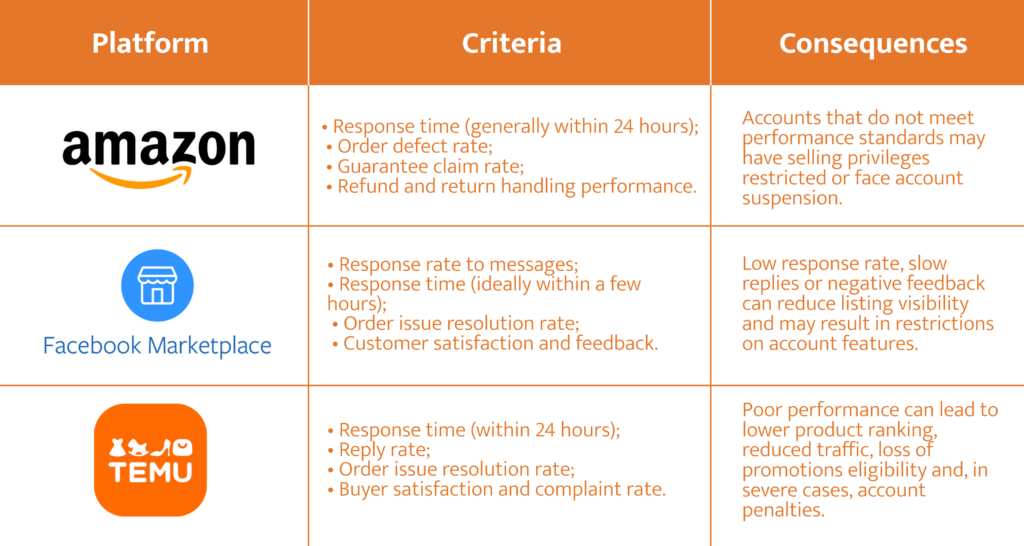
In practice, monitoring these metrics means understanding that marketplace customer service cannot fluctuate based on the day’s demand. The SLA remains the same; what changes is the volume of customer inquiries, and the operation must be able to absorb those fluctuations without compromising performance.
Why internal teams struggle with marketplace customer service during peak demand
However, small in-house teams often perform well under normal conditions but struggle when demand increases suddenly. And it is precisely during these peak periods that marketplace SLA requirements become even more critical.
Some signs that your internal team is struggling include:
- Pre-sales inquiries answered hours later, after the customer has already purchased from
another seller; - Customer complaints and dispute cases piling up, increasing the risk of damage to your seller reputation;
- Multiple marketplaces being managed by only a few agents, with no coverage outside business hours;
- A drop in seller status immediately after major promotional events, when visibility should be increasing.
Therefore, hiring additional in-house staff solely to cover seasonal peaks is often not financially viable. In practice, it means maintaining excess capacity for most of the year just to handle a few weeks of increased demand.
In this scenario, outsourced marketplace customer service becomes a more efficient solution. With a specialized partner, operations can scale alongside the promotional calendar, expanding support capacity as demand grows without permanently increasing payroll costs.
How marketplace customer service affects ratings and search visibility
There is one factor that many sellers still underestimate: marketplace customer service directly influences the platforms’ search algorithms.
Every low rating on a marketplace can mean a lower position in search results, and every minute without a response is a potential sale won by a competitor.
Sellers with below-average customer support ratings lose visibilityacross the platform. Their listings appear lower in search results, receive fewer clicks, and ultimately generate fewer sales. In other words, a customer service issue doesn’t affect only the dissatisfied buyer; it impacts the entire product catalog by reducing the visibility of listings that were never involved in the original complaint.
This creates a dangerous cycle:
- Delayed customer service leads to complaints or low ratings;
- The seller’s account reputation declines;
- Product listings lose visibility in search results;
- Sales decrease, putting even more pressure on an already overloaded support team;
- Customer service deteriorates further, reinforcing the cycle.
Breaking this cycle requires treating customer service as a core business strategy rather than simply a back-office operational function.
Outsourced marketplace customer service: scaling support without increasing costs
Activox designs marketplace customer service operations tailored to the fast pace of digital retail, combining scalable support, specialized teams, and continuous performance monitoring.
Our solution includes:
- Omnichannel customer support: Integrated chat, WhatsApp, email, and phone support covering both pre-sales and post-sales interactions;
- Marketplace-trained specialists: Agents who understand each platform’s policies, dispute resolution deadlines, and communication standards;
- Scalable operations for peak periods: Additional support capacity for Black Friday, seasonal events, and marketplace campaigns without relying on emergency hiring;
- Performance monitoring: Continuous tracking of response times, seller reputation, and customer complaints, with proactive adjustments to ensure SLA compliance.
With a 100% digital, bilingual operation available 24/7, Activox already handles more than 350,000 customer interactions per month for an international retailer, maintaining consistent service quality even in high-volume, complex operations.
Activox develops customized customer service solutions for both e-commerce stores and marketplaces. Contact our team to learn how our approach can help you maintain your SLA performance, even during peak sales periods.
Frequently Asked Questions
Perguntas frequentes
Marketplace customer service refers to the support provided to customers on platforms such as Mercado Libre, Shopee, Amazon, and other online marketplaces. It includes pre-sales inquiries, post-sales support, and complaint handling, all while complying with each platform’s rules and Service Level Agreements (SLAs).
An outsourcing partner manages customer service with agents trained in each marketplace’s policies, processes, and performance requirements. The operation can also scale during peak demand periods, eliminating the need for sellers to hire and train additional in-house staff.
The biggest challenges include unpredictable seasonal demand, managing multiple marketplaces simultaneously, meeting platform SLA requirements, and handling customer ratings and public complaints effectively.
Sellers with below-average customer service performance tend to rank lower in marketplace search results because response times, customer satisfaction, and seller reputation are key ranking factors. Lower visibility leads to fewer clicks and, ultimately, fewer sales.
Penalties vary by platform but generally include reduced seller reputation, lower listing visibility, restrictions on selling privileges, and, in repeated cases, account limitations or suspension.
Yes. A specialized outsourcing partner can scale operations according to seasonal demand, maintain platform SLA compliance during peak sales periods, and reduce the risk of reputational damage without increasing your company’s permanent staffing costs.